Showing posts with label C. Show all posts

Sunday, September 4, 2011

The Forgotten Garden

The Forgotten Garden by Kate Morton

A tale within a tale within a tale...

1913: A portmaster on some Australian coast finds a small girl on an English ship that has just arrived in Australia. The little girl has no recollection of her name and is carrying nothing but a small suitcase containing a book of fairy tales. The portmaster has no choice but to bring the small child home. Day after day, he and his childless wife wait to hear news of some family searching for the girl, but no news appear. Eventually they claim her as their own.

Nell grows up to be the apple of her father's eye, the delight of her mother and younger sisters, and one of the most beautiful girls around. But on her 21st birthday, her father chooses to reveal a deep secret: Nell is not their biological daughter.

And she disconnects. Breaks her engagement. Becomes distant from her family. Moves away.

1976: Now 65, Nell finally decides to attempt to trace her true roots. (Yeah, I know. Doesn't it seem like she would have done more of that a lot sooner?) Nell eventually discovers where she is from, but not much else surrounding her mysterious arrival in Australia or why she was abandoned and by whom. Although she wants to go back to England to continue her search, her own daughter leaves her granddaughter, Cassandra, with her for a few weeks. And those weeks turn to years.

2005: After Nell dies, Cassandra learns her grandmother's dreadful (sarcasm on my part) secret and takes up the search. The search leads back to a rich family in England. A rich, young lady named Rose and her cousin Eliza, an author of fairy tales. Cassandra works tirelessly to discover who Eliza is and why she would have taken Rose to another country.

So this is really and truly a tale within a tale within a tale: rotating between Cassandra's continued search for Nell's origins to Nell's own search during 1975 to Eliza's own story at the turn of the century.
And sometimes Eliza's own fairy tales are inserted between these chapters.

It's a lot, right? That's my primary complaint. The story of how little Nell got to Australia is a compelling and worthwhile one, but the narratives that follow Nell and Cassandra as they unravel the mysteries are not. And neither are the fairy tales. And neither are the many side characters that pop up in Cassandra's story. I don't care about Ruby, the daughter of an Australian Cassandra knows, who now lives in England. I don't really care that Cassandra is falling in love with the English gardener. I don't care about the woman who bought Rose's family estate and turned it into a hotel. I just don't care. In fact, I found myself skimming a lot, sometimes skipping pages outright.

All in all I only made it through this 549 page story because Eliza is a compelling character, as is her cousin Rose. Unfortunately, we don't hear nearly enough from them.

Grade: C


Sunday, April 10, 2011

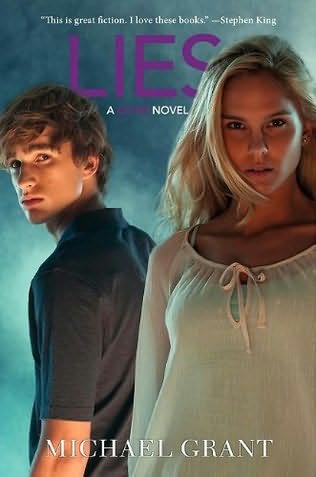
Lies

by Michael Grant

In the third installment of the Gone series, way too many things happen... So it's business as usual for the world of the FAYZ.
  • Sam has ceded control over to the council: A council that is much to slow to make decisions or take action.
  • The Human Crew forms; it's a freak-hate group.
  • A prophetess named Orsay is communicating with those outside the FAYZ.
  • Mary Terrafino, who cares for the children in the nursery, has become overburdened and under-medicated. 
  • Astrid and Sam argue.
  • Oh, and Brittany - the girl who died during the nuclear power plant fight - comes back from the dead.
  • And Drake, too.
Listen, tons of other stuff develops, too, but I read this book two weeks ago. Grade-wise, I would probably give this a C+. Too much happens, and the storyline becomes burdensome with so many different angles to it. However, there were a few redeeming qualities. Astrid's character is developed more. She's conflicted and arrogant. In a way, she's one of the better developed characters. Grant has gone about giving this goody-goody such sharp edges that make her hard to like. Unlike, strangley, the bad-girl Diana, with whom (I assume) most readers probably empathize. I found the whole storyline with Mary Terrafino to be terribly long and boring. For a girl suffering from way too much responsibility, depression, and an eating disorder, I found it hard to even want to pay attention to her.

So, all in all, this book had its slow moments. But in the end, it's about the mystery of the Darkness and Little Pete. What does this five-year old autistic child have to do with the FAYZ?

Grade: C+

Sunday, February 27, 2011

I Am Number Four


by Pittacus Lore

An alien race called the Mogadorians destroyed the planet Lorien. John Smith is one of nine alien children who escaped the destruction that occurred on Lorien. One of nine children with superpowers. Accompanied by their guardians, the nine arrived on Earth and have been living lives on the run, hiding from the Mogadorians who are out to finish them their race off.


The Nine are bound together by a charm that only allows the Mogadorians to kill them in order. John Smith is number four, and he is next.

Living a life constantly on the run has not been fun for young John Smith or his guardian, Henri. When fate finally lands them in Paradise, Ohio, John decides he’s ready to develop roots. He finds a friend and falls in love. As the story progresses and as John becomes more comfortable with his life in Paradise, the Mogadorians draw closer.


My review?

This story is one dimensional. There’s not a lot to drive the plot forward other than the Mogadorians, and the rising action doesn’t really create the suspense or tension readers enjoy with good action/adventure/mystery storylines. The character development is minimal; by the end of the book, I hadn’t really developed a connection with any of the characters. In fact, the character I liked the most was Bernie Kosar, John’s pet beagle.


The writing is one part sophisticated, one part middle school. The writing style is polished, but there is a lack of restraint that I also find in middle school writing. Overbearing, unnecessary descriptions of places. Details added in that seem to add little. Poorly explained background stories or descriptions. Beasts and turns of events added just to create more chaos. That's a typical middle-school writing trick: just adding extraordinary stuff on the fly just for shock effect. Ad-lib writing and "just because" justifications.


However, the book pulls together in the end because of the introduction of one compelling character: Number Six. It’s for this reason that I leave this book off with a B-/C+. Because it left me hope that the next book would be better.


Grade: C+

Tuesday, July 20, 2010

The Passage by Justin Cronin

The Passage by Justin Cronin. It's, like, the 'it' novel for the summer. Or at least the sci-fi-vampire 'it' novel. So I ran out and got it. And it is looooooooooong. Here's what Ron Charles of the Washington Post has to say:

"Imagine Michael Crichton crossbreeding
Stephen King's "The Stand" and "Salem's Lot"
in that lab at Jurassic Park"

That's exactly my thought!! Except I might have added a bit of Dean Koontz. (Okay, I've only read Door to December, but still... The Passage feels a bit Koontz.) And I might have added King's Charlie McGee (the little firestarter from Firestarter).

But this is the thing: I love vampires. And I LOVE MICHAEL CRICHTON. And I have a deep respect and enjoyment of Stephen King. So this is, like, perfect, right?

Well, it is and it isn't. I love that vampirism is turned into a coldly scientific and unromantic virus. I love the background story. I mean, who doesn't love an origin story? as my husband would say.

The first two hundred pages are the origin story with all its juicy science-y stuff. Introduced are a hard-nosed FBI guy and an abandoned, precocious little kid. The precocious little kid is purposefully infected with the virus, thanks to US Military's scientific need for research. Loved it.

The rest of the 600 or so pages cover what the world in like 100 years into the post-virus future. A small community has survived called "The Colony." They live in a large compound that is powered by wind turbines, which help the lights stay on. Because the lights have to stay on. There are vampires about, remember?!? Except they call them virals. I agree with Ron Charles's astute criticism: this is where it got a little slow for me. There is so much detail about everyone in this community and their history; it gets tiresome. The story picks up momentum as a group from the colony leave their community, searching for an answer, other humans, something...

I liked this book. Crisp and fun at the start, a bit soggy in the middle, but a delectable end.
Anyway, I'm posting Ron Charles's review here.

BTW, although this has been purchased for its movie rights, I do not think a feature film is the way to go. I know it's risky, but I really believe this story would do better as a mini-series (like The Stand, V, etc.) The Passage is interesting because it takes the time to weave so many stories, and a movie wouldn't be able to do that. (I know! I just complained that the book was too detailed and too long, but I didn't sit down for just an hour or two every Monday night to read it.) The Da Vinci Code worked out well, because in the end, it was about the code - not about the people. But The Passage is about the people not the, necessarily the virals. It's about how they cope with their situation. How they put together the small clues to their future and past. It would really lend itself to a mini-series. Ohwell.

Friday, July 9, 2010

Three Cups of Tea - Young Adult Version

Three Cups of Tea

The recounting of an American's work to start schools for children in Pakistan.

I read the Young Adult version, and I have no idea how one would get through the adult version. The content, the ideas and the actions, are awesome. It's inspiring... But boring. I read this because our incoming 6th grade students have to read it for Summer Reading. The YA version of Three Cups of Tea for an adult? I would give it a B. For an 11 year old? I would give it a C-. I just don't think most sixth graders have the reading level to handle so many foreign names, nor do I think they have the ability to sustain their interest through the less exciting parts.

Having read this, I can say that I hope for the following for my school:
  • We start some type of collection to help Greg Mortenson's Central Asia Institute. Otherwise, what is the point of reading a book about how we can change the world with just a few pennies?
  • They show some type of documentary/video version of this book to the sixth graders. I think it will fill out their understanding of the book. Also, everyone likes videos.

Grade: C

Friday, June 18, 2010

Lady MacBeth's Daughter

Lady Macbeth's Daughter is a new take of Macbeth. It's written by Lisa Klein, the same author who wrote Ophelia. I never really appreciated Macbeth when I read it in high school. However, four years ago I subbed for an English teacher for two months. We read Macbeth. For the first time, I really enjoyed it. The story of people so driven by power and greed that they are blind to their inhumanity. Blinded by prophecies. Ready to grasp any straw that hints of their superiority. Throughout it all, you can't help but remember that in the beginning, Macbeth and Lady Macbeth seem pretty normal and kind of nice. Logical. Upward climbing but in a rational sense. By the end, so much death, blood, and cruelty has occurred at their hands. I've never bothered to add up how many died: Duncan, Banquo, MacDuff's children...

However, this review is about Lady Macbeth's Daughter. The book is told from the first person perspectives of Lady Macbeth (whose name is Grelach in the book), and Albia, her daughter. Albia was born crippled. Macbeth ordered the baby to be left for the wolves. Grelach's maid rescues the child and brings her to her sisters' home. These three sisters are the weird witches of the play. The oldest sister prophecies that Albia has the second sight, but Albia does not want to accept her gifts. Regardless, Albia grows up living a pleasant country life until she is a teenager, where she is sent to train as a lady's maid at Banquo's house. Up until this point, Albia is a flightly, one-dimensional teen with a slightly odd home life. Honestly, I had little interest in Albia until romance blossomed between her and Fleance, Banquo's son. Albia becomes stronger when she learns of her true heritage and vows to avenge her father. Eventually, she begins to accept her second sight, but this ability felt like an easy out: an easy vehicle that enabled Klein to get Albia involved in Dunsinore. She becomes slightly more compelling regarding the battle of Dunsinore, but not much.

I enjoyed Klein's portrayal of Lady Macbeth much more. Klein has given LM children: one alive and one lost. She a mother overwhelmed by the loss of her daughter. She spends a lot of time depressed. This does not seem to be the Lady Macbeth of the play - specifically the beginning. What I did especially like about this version of LM is constantly aware of her precarious situation as a woman: always eager to stay in Macbeth's favor. This seems very realistic given the time period, when a woman's fate was that of her husband's whims.

The LM in the book portrays more of her maternal/feminine side. The masculinity that she displays in the Shakespeare's play is not evident enough to make not of. Klein's LM is the one who would say (as she said in Shakespeare's play)

"I have given suck, and know/How tender 'tis to love the babe that milks me..."

But not the LM who continued on by saying "I would, while it was smiling in my face,/Have pluck'd my nipple from his boneless gums,/And dash'd the brains out, had I so sworn as you/ Have done to this..."

The book contains bits of the above lines, but loses the full violent impact:

"I know how tender it is to love the babe that milks me. But my body has betrayed me, refusing to bring forth any more life. Now it is time to use death as my means." (63)

LM's insanity is downplayed, and I don't recall any "Out damned spot" moment either. And LM lives! That was disappointing, too. The ending was just too sweet: Albia and LM reunite to repair their broken relationship.

All in all, I appreciated Lady Macbeth's view points and the battle scenes, but little else appealled to me. However, I think this is a great companion piece for those who have read Macbeth or will be reading it shortly. In addition, if you really like Ophelia by Klein, you will probably enjoy this one, too.

Grade: C+

(Painting of Lady Macbeth by John Singer Sargent (1889), one of my favorite painters.)

Sunday, May 30, 2010

Pitch Black: A Graphic Memoir

This is a graphic memoir about a man who lives in the unused tunnels and rooms of the NYC subway. I believe such individuals have been given the nickname "moles" or "mole people." This was a super-quick read: the size of a normal children's picture book. In fact, I thought it was a civil rights type of book for children. Needless to say, it wasn't. I didn't really care for it much with the exception of two points:
1. There is a YA novel called Slake's Limbo, which is about a young boy in the foster care system who escapes into the underground world of the subway to escape abuse.
2. The line: Just cause you can't see don't mean aint nothing there.

For a much more sophisticated review, check out this out from the NYT.

Grade: C+

Tuesday, April 20, 2010

Let the Right One In: A Vampire Novel for Adults


Let the Right One In by John Ajvide Lindqvist is a vampire novel. The most unromantic and depressing vampire novel I have ever read. There is nothing seductive about vampirism in this novel. The thrill and fascination for death, immortality, and power are nil. This is a vampire story by Wally Lamb: gray, depressive, and in need of a real anti-depressant. The back of the book claims that the author is “Sweden’s Stephen King.” If that is so, I am eternally grateful that I live in America. If King’s works seem a tad less serious, the impression they leave is still as lasting as this story and yet much more engrossing.

Oskar, a 12-year-old misfit, is ostracized and bullied to the extreme. He really has no one with whom he can connect with other than his mother, who seems to be just as desperate and lonely. No one really understands the extent to which he is subjected to cruel and inhumane harassment from bullies. No one tries to alleviate the problem. Oskar fantasizes about killing his bullies, and this is where you begin to question the empathy you developed for him. Is this kid whack-o? Is he going to go crazy and kill everyone? But as soon as you develop an aversion to Oskar, Eli enters the storyline and pulls you back in.

Oskar meets the strange, waif-like girl in his apartment complex's playground one night. He is unused to any attention that is not scornful. She, too, seems lonely. From the get-go, the narrator lets you know that Eli is a vampire and that her situation is as sad as the dull, cold apartment complex in which she and Oskar live. Due to her child-like appearance, Eli must live with an adult: a pedophile who is willing to kill for her and clean up the mess. In no uncertain terms is vampirism made appealling. Her situation is not glorified: she is a killer. When Eli hasn’t fed, she becomes old and decrepit looking. She often smells.

However, there is something between Eli and Oskar. Some understanding between their souls, some understanding of the quiet loneliness they both live with. They become friends. An odd friendship comprised of meeting at night and communicating through walls using Morse code. But this friendship, however strange, seems to give Oskar a little more strength in daily life.

It is Eli, primarily, and Oskar whom you want the story to develop around. However, there are so many subplots to the story that weave in and out, dampening my enthusiasm for the book. There’s the group of alcoholics that have little in their own lives but each other and the need to drink. There’s the pedophile that is willing to kill for Eli who has his own depressing and repellent background. There’s Oskar’s own sad alcoholic father. The author even develops the stories of the main detective who investigates the mysterious murders. And the story of his girlfriend and her drug-addict son, Tommy. Even the background of the main bully is explored. There’s just too much in the way of character development, and I’m not sure if it really adds much to the story….

Except to focus on the complete lack of connection these characters feel to any other human in their lives. So little love is displayed. So little enthusiasm for life.. And why would that be relevant other than to depress us? Well, it highlights the fact that maybe Oskar and Eli’s friendship isn’t all that odd. In a place with so little life, so little warmth, so little to hope for, perhaps Eli is a good choice as a friend.

Grade: C+

Saturday, April 25, 2009

Eaters of the Dead

Eaters of the Dead by Michael Crichton

A great take on Beowulf. Once again, Crichton uses a "pseudo-documentary" style to help "authenticate" his works. The entire book takes the form of a scholarly compilation and translation of ancient copies of Ibn Fadlan's journey from the Middle East to the north. While journeying north, he is forced to join a group of men who are returning to their homeland to battle mist creatures that attack and savagely kill their countrymen.

This was a fun read. I would write more, but I'm working on the BEST.

Grade: C+

Monday, March 2, 2009

Ink Exchange

Ink Exchange by Melissa Marr

(
Warning: This book is marketed as YA, but I would not recommend it to anyone under 14. Depictions of sex and violence are a little mature and offer no real reflection to help a younger reader process it.)

A companion piece to Wicked Lovely, this story sets Aislinn’s friend Leslie as the protagonist. Leslie is ignorant of the fantastical changes that have overcome her friend. Aislinn is now Queen of the Summer Fairies. In fact, Leslie is unaware of the existence of fairies at all. She is only aware of the new presence of several overwhelmingly attractive and enigmatic people whom Aislinn now calls friends. Despite some of these odd changes, Leslie is preoccupied. She is hiding many dark secrets from her friends: the deterioration of her home life, an alcoholic father, and an abusive and drug-addicted brother. In the chaos of her life, Leslie is trying to keep it together and take control. It’s a tightrope balanced walk, and one way that she tries to regain control is through the reclaiming of her body with a tattoo.

Leslie finds herself mesmerized by a particular tattoo that is special and unique. Unbeknownst to her, it is the tattoo of the King of the Dark Fairies, Irial. The Dark Fairies, who feed off of negative emotions, have been going hungry ever since Aislinn gained rule and the reigning Winter Queen, Beira, was ousted. Beira had kept the emotional pot of fairy emotions at a constant boil, and there was no end to sating the evil fairies’ appetites. Now that a kind rule has come over the fairy world, the dark fey are starving, and Irial must devise a new way for them to feed.

Leslie’s tattoo is more than mere mortal body art. It is an ink exchange, which will link Irial and her together, allowing Irial to filter all of humanity’s emotions through her. While she detests having been used, Irial’s magnetic power is overwhelming. Leslie at turns fights being used as such a tool, and at other moments prefers her tethered state to her previous sad life.

Irial’s court is truly a dark one. Humans are used and abused in the foulest ways so the fairies may extract the fullest range and depth of negative emotions: lust, greed, pain, gluttony, rage, and insanity...

The character development of the main characters, Leslie, and Irial, is good. Most spectacular is the descriptive and emotional language that shows up regularly. However, I still feel as though the background story is not fleshed out enough. Readers are left asking too many questions about side characters and practical questions about fairies. What exactly happens to a fairy that starves? What exactly do fairies do? What is their purpose? The holes in this book caused me to put this book down several times and ask, “What is the point? Do I really even care to know the end?” I persevered, and I can’t really say I felt a sense of satisfaction at completing it.

GRADE: C

Sunday, February 8, 2009

Eager

Eager (YA) by Helen Fox.


I got this sci-fi book at a school book fair. I was intrigued by what seemed to be a story about robotics and ethics. The stuff of Asimov and Bradbury (but more Asimov). I was so intrigued that I bought it, put it on my shelf, and promptly found many other books to occupy me. Last week, however, I had the kids voting for the Nutmeg Awards (Connecticut's YA and Children's Book awards, which are chosen by the kids themselves). Eager was one of the nominations. I was shamed by the fact that I had only read two of the many choices, and yet I owned most of them! And so I set to work...

Eager is set in a world about 100 years into the future. Robots help run everything - from construction to egg scrambling. Life Corp is the primary robotics corporations, and they have just begun distributing their latest product, the BDC4. These robots are efficient and exceptionally life-like. They are only for the most wealthy and privileged - the technocrats.

Young Fleur Bell and her family have an old antiquated robot named Grumps. Grumps' timing mechanism is off - causing all sorts of mishaps like tomato soup for breakfast. The Bells know they need a new robot, but they are reluctant to part with Grumps or deal with the high cost. Fleur's best friend has her own BDC4. While the Bell children dream of the newest and latest, Mr. Bell acquires an experimental prototype named EGR3. EGR3 is able to learn from his own experiences. The children, especially Fleur, are not so eager to accept EGR3 but as EGR3 becomes more life-like they come to rely upon him - especially when the BDC4s of the world begin malfunctioning!

This was a fun read. I enjoyed the descriptions of life in the future, but I felt that the conflict of the plot was rather subdued. The terrifying takeover of a group of BDSC4s wasn't depicted as being really that terrifying. It feels as though the author had a great time writing until right before the start of the climax (which I will state is the moment in which Marcia announces that the BDC4s have taken over her neighborhood), and then just got tired. The details after this point seem muted and more like a summary.

Grade: C+

Thursday, January 22, 2009

Rhett Butler's People

Rhett Butler's People by McCraig.

I read Gone with the Wind (GWTW) during my Freshmen year of high school. I read it at home. I read it on the bus. I read it placed discreetly under my desk during Biology. I eagerly awaited the arrival of the prequel Scarlett. On Christmas Eve, my Aunt Camille gave me a copy. My mother had to hold it hostage until we went home - all to ensure that I did not hole up in a wall and read through the family dinner.

GWTW? Politically incorrect? Lacking true reflection on slavery and the South? Guilty. Fantastically mind-boggling great read? Beyond a shadow of a doubt.

Ripley's Scarlett? Scarlett is where a yarn becomes too far-fetched and unbelievable. But I still ate it up. That book was done in a day.

Rhett Butler's People? IDK. Is it that I am an older, more discerning reader than when I read Scarlett? Perhaps.

This book takes on too much. Too much time (two decades) and way too many characters. Although this book focuses on Rhett's perspective and fills in the details of his childhood and youth, it doesn't do much for the character. The stars of the show, in fact, are poorly done in general. Scarlett, Rhett, and Melanie: I was displeased by the characterization of all three. Scarlett came off as being less a determined fire-brand. Rhett was described in detail, and yet the reader still never gains a greater understanding of why he loves Scarlett so much. Or why he considers them uniquely similar. And Melanie? Perhaps the mysterious, saintly aura of Melanie is better than a tepid attempt to tell her side of the story.

Where McCraig does shine is when he isn't focusing on GWTW. A large part of the book focuses on Rosemary Butler, Rhett's younger sister, and her struggles with survival and love. I also really enjoyed reading from Belle's perspective. Quite frankly, these two characters could have separately sustained their own novels.

The beginning of this book dragged on like few do for me. For the first 250 pages, I graded this as an F. The subsequent 150 or so pages picked up quite a bit. The excitement that grew as the pages turned, however, was shattered at the very end. The Klan wants to exact revenge on Rhett, so they vandalize and terrorize Tara. Death and fire ensue. It was just a bit too much. But still, by the end, I was so sad to see Scarlett and Rhett and the remaining GWTW gang go.

Grade: C+/B-

Thursday, January 1, 2009

The Magician's Nephew

The Magician's Nephew by C.S. Lewis

After finishing Silas Marner, I was lost in regards to reading. Generally, I easily alight on a new book without much difficulty. I may not read quickly all of the time or rabidly, but I usually do have something that I enjoy reading nearby. Not so for the last few weeks. Metaphorically speaking, my search for a read has been akin to a night full of tossing and turning - looking for the best, coolest spot on the pillow.

I finished most of a Brave New World (a re-read), carried around the sequel to Wicked Lovely, and began a YA novel of unknown title that my sister said was good. But nothing really settled. I finally sat down, determined. I would begin reading the Chronicles of Narnia series. I had watched the two movies again - HD Blu-Ray, and I thought that I should really learn more.

I've started with the first: The Magician's Nephew. This book was written after The Lion, The Witch, and the Wardrobe and tells the reader of the creation of Narnia.

Digory and Polly are two London children who find themselves thrown into another world due to the work of Digory's magician uncle (hence, the title). While hopping through worlds, they accidentally awaken the evil queen Jadis (who later becomes the White Witch) and bring her back to London. There she wreaks havoc on all sorts of things, and the children successfully maneuvered her out of our world and into an unborn world - the future world of Narnia. While floating in this unformed world, the group (for the children bring more people than intended), the birth song of the world - sung by Aslan - is heard. Aslan's song brings the world and its creations into being. Aslan gives chosen animals thought and speech.

The shame of this beautiful new world is that the son of Adam -Digory- brought evil into the Narnia, that being Jadis. Digory is sent on a mission by Aslan: to find and return with a powerful silver apple, but not to be tempted to eat it. Digory resists the temptation and returns with the apple. However, Jadis finds the tree and eats from it. When Digory returns to Aslan, they plant the apple, which Aslan tells the creatures it will provide them with protection against the White Witch. As a reward, Aslan provides Digory with another silver apple to help save his dying mother back in Earth. When the children return, Digory revives his mother with the apple and then buries the apple core and all other magical paraphernalia in the ground. A tree grows. This is the wood from which the wardrobe was created.

My Thoughts:
This is a dry read, one definitely more fit for illustrations because the text isn't exactly absorbing. The action sequences are low-key, and the story line is not movie-made. However, it does provide nice background info for The Lion, the Witch, and the Wardrobe. I kind of like to the think that the Bartle book by Rowling probably has a similar feel.

Regardless, this was a fun and quick read. I enjoyed the background info and I really like the fact that I know why there was a lamp post in the middle of the woods in the movie.

Grade: B-/C+

Side Note: At one point the newly born creatures of Narnia mistake the uncle for a talking lettuce. This made me think of a story about cabbage that could talk and feel. It was written by Bergerac in a book called The Other World. Anyway, I googled it and found that C.S. Lewis has a book of compiled essays and stories called Of Other Worlds. Connection? IDK.